
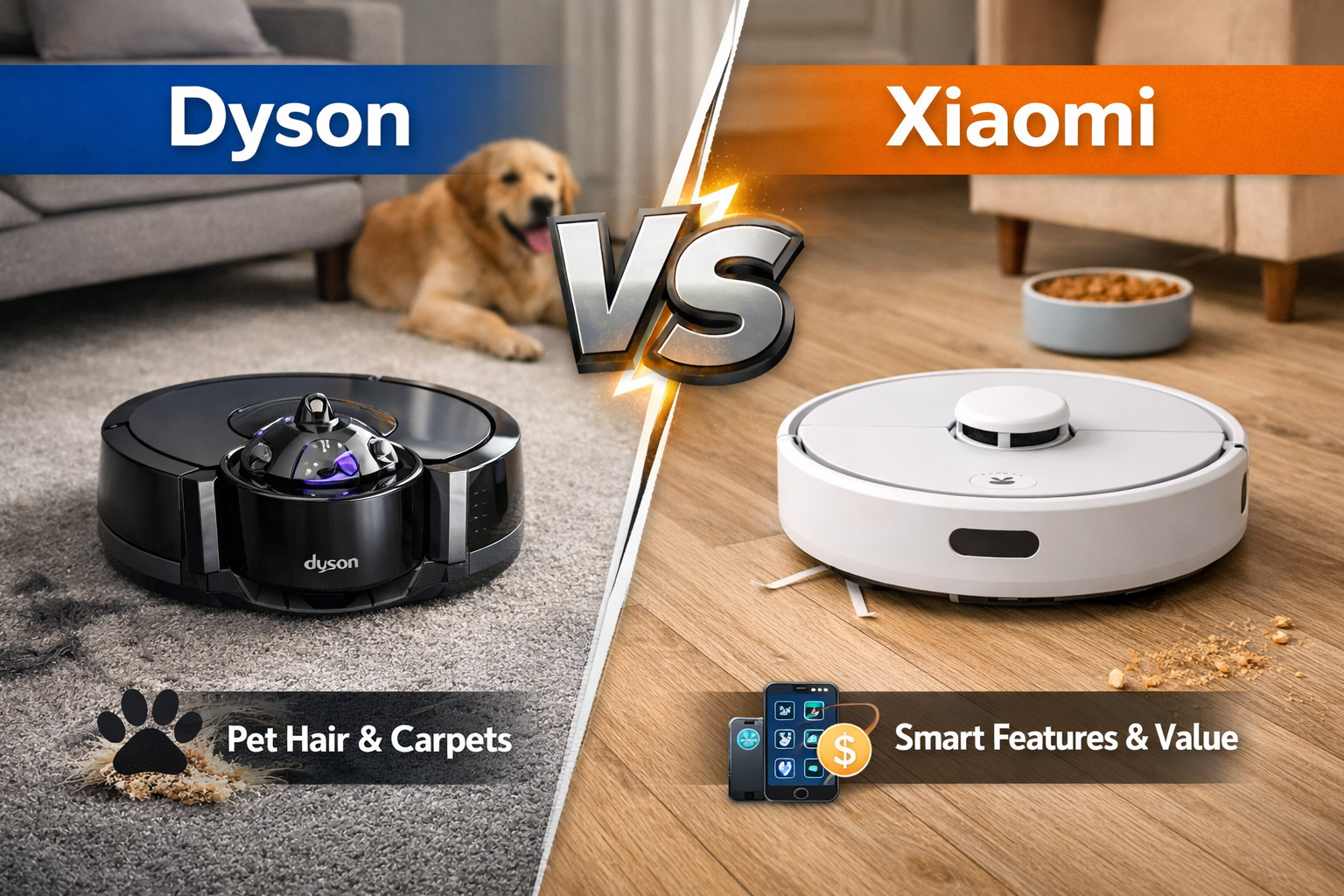
Choosing a robot vacuum in 2026 is no longer about basic cleaning. Real buyers want reliability, intelligent navigation, strong suction for pet hair, low maintenance, and an app that actually works day after day. This is exactly why the Dyson vs Xiaomi robot vacuum comparison matters right now.
I have tested multiple robot vacuums across apartments, pet-friendly homes, and mixed flooring layouts. Some look impressive on spec sheets but fail in real homes. Others quietly outperform expectations. This guide is written for buyers who want clarity, not marketing fluff.
If you are confused between a premium brand like Dyson and a value-driven ecosystem player like Xiaomi, this comparison will help you make a confident purchase decision.
This article is for:
- Apartment owners with limited space
- Pet owners dealing with fur and dander
- Smart home users who value automation
- Buyers comparing price vs real-world performance
Dyson vs Xiaomi Robot Vacuum Comparison Table
| Feature | Dyson Robot Vacuum | Xiaomi Robot Vacuum |
|---|---|---|
| Cleaning Power | Extremely high suction, deep-clean focused | Balanced suction, optimized efficiency |
| Best For | Premium homes, carpets, pet hair | Apartments, tiles, value buyers |
| Navigation | Advanced vision-based mapping | LiDAR + AI mapping |
| App Experience | Minimalist, stable | Feature-rich, customizable |
| Noise Level | Moderate to high | Generally quieter |
| Maintenance | Higher cost, fewer parts | Low cost, easy availability |
| Price Range (2026) | Premium | Budget to mid-range |
| Smart Home Integration | Limited | Strong (Alexa, Google, Mi Home) |
If you want a fast takeaway: Dyson prioritizes raw performance, Xiaomi prioritizes smart efficiency and value.
Cleaning Performance (Carpet, Tiles, Pet Hair)
This is where the Dyson vs Xiaomi robot vacuum debate becomes practical.
Carpet Cleaning
Dyson clearly leads on carpets. Its suction system is built to lift embedded dust and pet hair from thick fibers. In homes with rugs or wall-to-wall carpeting, Dyson consistently pulls out more debris in a single pass.
Xiaomi performs well on low to medium pile carpets but relies more on multiple passes rather than brute force. It compensates with intelligent route planning instead of raw suction.
Tile and Hardwood Floors
On tiles and hard floors, Xiaomi often feels more refined. It maintains steady suction without scattering debris. Dyson can be slightly aggressive, which is great for deep cleaning but sometimes unnecessary for smooth surfaces.
Pet Hair Reality Check
As a pet owner test case, both brands handle daily shedding well. Dyson excels during heavy shedding seasons and with long-haired pets. Xiaomi performs better for daily maintenance and quiet operation, especially if pets are sensitive to noise.
If pet hair is your primary concern and budget allows, Dyson has the edge. For routine cleaning in pet homes, Xiaomi is more than sufficient.
If pet hair is your biggest concern, especially in homes with dogs or cats that shed daily, you should also check our detailed guide on best vacuum cleaners for removing pet hair to compare dedicated models built specifically for fur-heavy environments.
Mapping & Navigation Technology Explained Simply
Navigation is the backbone of any robot vacuum. A strong motor means nothing if the robot gets lost.
Dyson Navigation
Dyson uses advanced vision-based navigation with high-speed processing. It “sees” the room and adjusts in real time. This works exceptionally well in well-lit homes and complex layouts.
However, low-light conditions can slightly impact efficiency, especially during night-time cleaning.
Xiaomi Navigation
Xiaomi uses LiDAR-based mapping combined with AI room recognition. This system is extremely consistent, even in darkness. Room division, no-go zones, and custom cleaning schedules are handled effortlessly.
For most apartments, Xiaomi’s navigation feels more predictable and user-friendly. In larger premium homes, Dyson’s adaptive system shines.
Battery Life, Noise & Maintenance
Battery Life
Xiaomi leads in battery efficiency. Many models comfortably clean medium-sized apartments on a single charge. Dyson consumes more power due to higher suction and may require recharge cycles for larger homes.
Noise Levels
Xiaomi robot vacuums are noticeably quieter. This matters if you work from home or schedule cleanings during calls. Dyson is not loud, but you will hear it working.
Maintenance Costs
This is a crucial long-term factor in the Dyson vs Xiaomi robot vacuum decision.
- Dyson: Higher replacement costs, proprietary parts
- Xiaomi: Affordable filters, brushes, and easy DIY maintenance
Over 2–3 years, Xiaomi is significantly cheaper to maintain.
Smart Features & App Experience
Dyson App
The Dyson app is clean and stable. It focuses on essentials: start, stop, schedules, and maintenance alerts. It rarely glitches, which is a positive, but customization options are limited.
Xiaomi App
Xiaomi’s Mi Home app is powerful. You can:
- Set room-specific suction levels
- Create advanced schedules
- Control mop + vacuum combos
- Integrate with Alexa and Google Assistant
For smart home enthusiasts, Xiaomi offers far more flexibility.
Price vs Value — Which Brand Makes More Sense?
This is where most buyers make the final call.
Dyson robot vacuums are priced for premium buyers who want top-tier performance without compromise. You pay more, but you get unmatched suction and engineering.
Xiaomi focuses on delivering 80–90% of the experience at a much lower price. For most apartments and daily cleaning needs, Xiaomi offers better value.
In 2026, the value gap has widened. Xiaomi keeps improving software and hardware while maintaining aggressive pricing.
Pros & Cons
Dyson Robot Vacuum
Pros
- Exceptional suction power
- Excellent for carpets and heavy pet hair
- Premium build quality
Cons
- Expensive upfront cost
- Higher maintenance expenses
- Limited smart customization
Xiaomi Robot Vacuum
Pros
- Excellent price-to-performance ratio
- Reliable LiDAR navigation
- Quiet operation and long battery life
- Strong smart home integration
Cons
- Slightly weaker on thick carpets
- Build feels less premium than Dyson
Which One Should You Buy?
Apartment Living
Choose Xiaomi. Efficient mapping, quiet operation, and excellent battery life make it ideal.
Pet Owners
If budget allows and shedding is heavy, Dyson performs better. For daily pet hair cleanup, Xiaomi still does a solid job.
Budget-Conscious Buyers
Xiaomi is the clear winner in the Dyson vs Xiaomi robot vacuum comparison for value buyers.
Premium & Performance-Focused Buyers
Dyson is designed for those who want the strongest cleaning performance available.
FAQs
Is Dyson better than Xiaomi for pet hair?
Dyson handles deep-set pet hair better, especially on carpets. Xiaomi is better for daily maintenance.
Which robot vacuum lasts longer?
Both brands are reliable. Xiaomi parts are cheaper to replace, which improves long-term ownership.
Can Xiaomi robot vacuums work without Wi-Fi?
Basic cleaning works, but advanced features require the app and Wi-Fi.
Is Dyson worth the extra money?
If you need maximum suction and premium build quality, yes. Otherwise, Xiaomi offers better overall value.
Which brand is better for smart homes?
Xiaomi integrates more smoothly with smart home ecosystems.
Final Conclusion
The Dyson vs Xiaomi robot vacuum comparison in 2026 comes down to priorities, not brand hype.
Dyson delivers unmatched cleaning power and premium engineering. Xiaomi delivers intelligence, value, and flexibility that fits real-world homes.
My honest recommendation:
- Choose Dyson if performance is your top priority and budget is secondary.
- Choose Xiaomi if you want smart, reliable cleaning with excellent long-term value.
Both are strong choices, but for most buyers today, Xiaomi simply makes more sense.
If you are ready to upgrade your home cleaning setup, this is one of the most informed decisions you can make this year.