
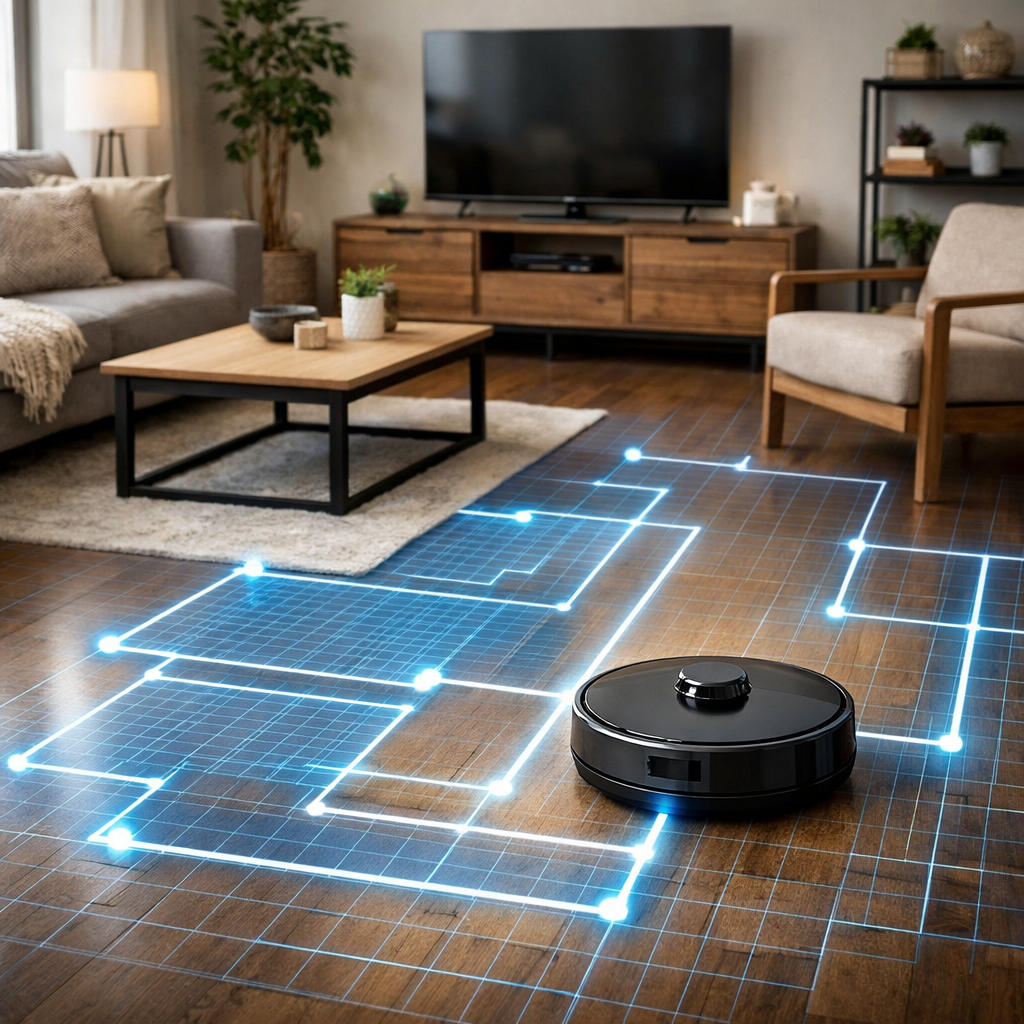
1. Introduction
If you’ve ever watched a robot vacuum bump into walls like it’s drunk at 2 a.m., you’ve probably wondered how does robot vacuum mapping work and why some models feel genius-level smart while others feel… dumb. That confusion is real, and it’s not your fault. The term “mapping” gets thrown around casually, but most explanations online are shallow, recycled, or straight-up misleading.
Here’s the real issue: people assume robot vacuums magically “see” their house like humans do. They don’t. Mapping is a calculated process built on sensors, math, and constant trial-and-error inside your home. When it works, cleaning feels effortless. When it fails, the robot gets lost, skips rooms, or cleans the same spot five times.
This guide breaks down how does robot vacuum mapping work in a way that actually reflects real-world use. No hype. No fluff. Just a deep, practical explanation based on how these machines behave day after day in normal homes with furniture, pets, cables, and chaos. By the end, you’ll understand exactly how robotic vacuum cleaners work, why mapping sometimes fails, and how to choose or use one smarter.
- 1. Introduction
- 2. How Does Robot Vacuum Mapping Work in Real Homes
- 3. Core Mapping Technologies Explained
- 4. How Robotic Vacuum Cleaners Build and Use Maps
- 5. Mapping Accuracy Problems Most People Face
- 6. Smart Features Powered by Mapping
- 7. Mapping vs Non-Mapping Robot Vacuums
- 8. Best Robot Vacuum with Mapping: Who Should Buy and Who Should Avoid
- 9. FAQs
- 10. Conclusion
2. How Does Robot Vacuum Mapping Work in Real Homes
2.1 Why early robot vacuums failed so badly
Before mapping existed, robot vacuums worked on pure randomness. They bounced off walls, changed direction arbitrarily, and hoped for the best. Cleaning coverage was inconsistent, battery usage was inefficient, and many spots were missed entirely.
The core problem was lack of spatial awareness. These robots didn’t know where they had been, where they were going, or what the room looked like. Every cleaning session was basically a reset. That’s why older models felt noisy, slow, and unreliable.
Mapping was introduced to solve one thing: structured cleaning. Instead of chaos, the robot needed memory. That memory is what we now call a “map.”
2.2 What “mapping” actually means (not marketing talk)
Mapping is not a single technology. It’s a process. When people ask how does robot vacuum mapping work, they’re really asking how a machine understands space.
In simple terms, mapping means the robot:
Identifies walls, furniture, and obstacles
Tracks its own movement in real time
Builds a digital layout of the area
Uses that layout to plan efficient cleaning paths
The map isn’t a picture. It’s a data model created using distance, angles, and movement tracking. The better the sensors, the better the map. And better maps mean faster, cleaner, less annoying cleaning cycles.
3. Core Mapping Technologies Explained
3.1 Gyroscope & sensor-based mapping
This is the most basic form of mapping. The robot uses internal gyroscopes, accelerometers, and bump sensors to estimate movement. It tracks how far it moves forward, when it turns, and when it hits something.
Pros:
Cheaper
Works decently in small, simple layouts
Better than random navigation
Cons:
Maps drift over time
Furniture changes confuse it
Less accurate room division
Gyro-based mapping answers the question of how does robotic vacuum cleaner work at an entry level, but it struggles in complex homes.
3.2 Camera-based (VSLAM) mapping
Camera-based mapping uses a visual sensor, usually mounted on top or front. The robot looks at ceilings, walls, and fixed reference points to understand location. This is often called VSLAM (Visual Simultaneous Localization and Mapping).
Pros:
More accurate than gyro systems
Good room recognition
Better path planning
Cons:
Needs light to work properly
Mirrors and reflections can confuse it
Less effective at night
Check Current Price & Mapping Features
Camera-based systems significantly improved how robot vacuum mapping work in apartments and mid-sized homes.
3.3 Laser-based (LIDAR) mapping
LIDAR is currently the most reliable mapping technology. It uses a spinning laser to measure distances in all directions, creating a highly accurate 2D or 3D map.
Pros:
Works in complete darkness
Extremely precise
Best for multi-room and large homes
Cons:
Slightly more expensive
The laser turret adds height
When people search for the best robot vacuum with mapping, they’re usually talking about LIDAR-based models because of their consistency and accuracy.
4. How Robotic Vacuum Cleaners Build and Use Maps
4.1 Step-by-step: from first run to saved map
Understanding how does robot vacuum mapping work requires seeing the process clearly:
1. First cleaning run scans walls and boundaries
2. Sensors record distances and angles continuously
3. The robot tracks its own movement in relation to objects
4. Data is converted into a digital floor plan
5. Rooms are detected and divided automatically
6. The map is saved in memory or cloud storage
During early runs, the map improves. This is why initial cleanings feel slower. The robot is learning.
4.2 How navigation decisions are made
Once a map exists, the robot stops wandering. It:
Plans straight-line paths
Avoids already-cleaned areas
Returns to missed spots
Optimizes battery usage
This is the moment where robotic vacuum cleaners truly feel “smart.” The difference between mapped and non-mapped behavior is night and day.
5. Mapping Accuracy Problems Most People Face
5.1 Why maps break, reset, or go wrong
Even the best mapping systems aren’t perfect. Common causes of failure include:
Moving furniture frequently
Picking up the robot mid-clean
Dirty sensors
Firmware bugs
When people complain that mapping “doesn’t work,” it’s usually environmental, not technical.
5.2 Floors, mirrors, pets, and furniture issues
Mirrors reflect lasers. Dark carpets absorb light. Pets move unpredictably. All of these confuse mapping systems. Understanding these limits helps set realistic expectations of how does robot vacuum mapping work in daily life.
6. Smart Features Powered by Mapping
6.1 Room selection, no-go zones, and schedules
Mapping enables:
Cleaning specific rooms
Setting virtual walls
Avoiding cables or pet bowls
Custom schedules per area
These features depend entirely on map quality.
6.2 Multi-floor and advanced control
Advanced models store multiple maps. This allows the same robot to work across floors without confusion. It’s one of the most underrated benefits of good mapping.
7. Mapping vs Non-Mapping Robot Vacuums
Mapped robots clean faster, miss fewer spots, and waste less battery. Non-mapped robots rely on luck. If efficiency matters, mapping isn’t optional anymore.
8. Best Robot Vacuum with Mapping: Who Should Buy and Who Should Avoid
Mapped robot vacuums make sense if:
You have multiple rooms
You want scheduled, hands-off cleaning
You care about efficiency
You should avoid advanced mapping models if:
Your home is very small
Furniture layout changes daily
Budget is extremely tight
This is where contextual product mentions and comparisons can be placed naturally, without forcing decisions.
9. FAQs
How long does robot vacuum mapping take?
Usually 1–3 full cleaning cycles depending on home size.
Does mapping work without Wi-Fi?
Basic mapping does, but smart features need connectivity.
Why does my robot keep remapping?
Sensor obstruction or major layout changes are common causes.
Can I edit the map manually?
Some models allow room merging or splitting through apps.
Is LIDAR better than camera mapping?
In most real homes, yes—especially for consistency.
Does mapping improve cleaning quality?
It improves coverage, efficiency, and predictability.
If you want to choose the right vacuum cleaner for pet hair cleaning, you can also check out this related guide.
10. Conclusion
Once you truly understand how does robot vacuum mapping work, the confusion disappears. Mapping isn’t magic. It’s a system built on sensors, logic, and adaptation. When used correctly, it turns a noisy gadget into a reliable cleaning partner.
The key is knowing what to expect, how to maintain accuracy, and when advanced mapping actually matters for your space. With that clarity, robot vacuums stop feeling gimmicky and start feeling genuinely useful.